|

Line Shrinkage & Incorrect Line Length
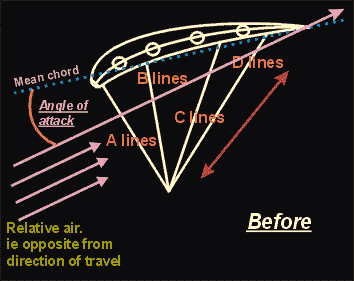 Depending on your line composition, this may or may not concern you. Nowadays paraglider lines are usually composed of minimum shrinkage composition however it is a good idea to be aware of the implications or check the line lengths, especially the rear ones (especially if you are flying in moist, humid coastal conditions) . A typical example of a glider with shortened rear lines is difficulty in inflating, especially under forward start conditions. I was having a problem once attempting to inflate my tandem wing that had not been used for near on a year. The next day we measured and stretched the lines, noting around four center meters of shinkage. So what does rear line shrinkage mean??
Well firstly, many manufacturers are lengthening the rear risers and slightly shortening the front risers to compensate for the increased angle of attack created by the pendulum motion of adding power on motorised paragliders. It is extremely important not to undertake any such procedure unless qualified to do so. By shortening the rear lines, one is effectively increasing the angle of attack which in turn takes the glider closer to the critical angle (the angle at which it stalls).
Here is an example of what exactly may happen should your lines be drastically shortened. I was test flying a new glider that flew quite well under non powered conditions, as there is no drastic change in the angle of attack. I had just taken off and undertaken what certainly was no radical powered turn when I felt the wing start to spin. I immediately came off the power and released the toggel. The glider then progressed into a parachutal stall. Realizing I was about to hit the ground with an extra 30 kg`s I attempted to drag the wing using power away from the edge where there was more height to play with. Looking back, this probably worsened things.
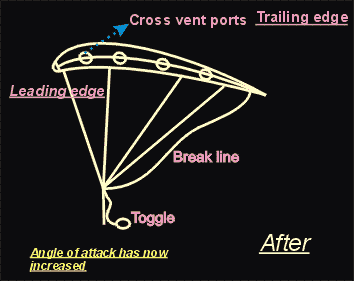 The way out of a parachutal stall is to decrease the angle of attack (and not increase it) by either pushing on the speed bar or gently on the front risers and or releasing the trims. Anyway, there was not enough height and I hit the ground. I immediately attempted to stand up and realized this was impossible. Looking down, I was amazed to see the underneath of my foot looking back at me and the tibia(the lower leg bone)which had disjointedfrom the ankle joint, had come out the side of my leg and now was firmly implanted into the ground (which had occured as I tried to stand up). The fibula (the other lower leg bone) had snapped under the impact. The veins and arteries had also balooned out where looking as if they were about to explode. Not managing to secure a chopper I was loaded into the back of my van and transported over a dirt track while one of my mates held the ankel and leg together which was attempting to disjoint itself from each other over every bump. Back on the hill life was returning to normal after a bout of nausea, fainting and chain smoking events. This was hurried along by a visit to the local pub before returning to the scene, where the remains of my lower leg, now looking like a piece of leather were found. Well, a plate with 6 screws and a number inside the ankle joint plus a 20 cm skin graft later, and I`m waiting to see the outcome.
LETS LOOK BRIEFLY AT WHY THIS OCCURED
With the rear lines being shortened, as one powers into a turn you are already entering under an unusually high angle of attack (from the short lines and the pendulum motion of the engine). Added to this the one sides angle of attack is being increased even more, due to the turn which resulted in the one side stalling(and stopping flying). With the other side flying around this stalled side, a negative spin was induced, with massive height loss.